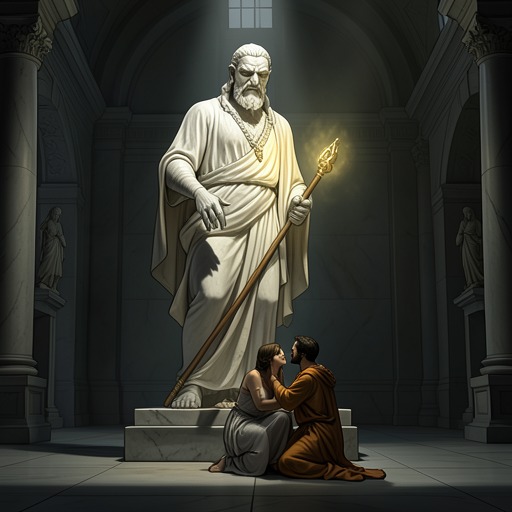
Jupiter and Io
Metamorphoses (Ovid Edition)Jupiter and Io presents divine desire as a cycle in which pursuit becomes captivity and metamorphosis becomes a means of concealment. Jupiter’s attraction to Io initiates the crisis, but the relationship is shaped less by mutual fulfillment than by evasion: Io flees, Jupiter changes her form, Juno claims control of her, and restoration is possible only when Jupiter formally guarantees that the nymph will not again violate Juno’s claim.
Desire and Pursuit
Io is returning from her father’s brook when Jupiter beholds her with desire. The encounter begins from Jupiter’s gaze and initiative, not from a declared mutual attachment. He addresses her as a fair daughter of the flood, while she responds by fleeing from his embrace. Her movement carries the relationship immediately into the pattern of pursuit: Io crosses Lerna’s pastures, and Jupiter follows the chase across the shades of the Lyrcaean plain.
The scene joins divine power to the language of seduction. Jupiter is presented as the ruler of sea and land, the wielder of thunder, and therefore as a suitor whose authority makes refusal unequal to consent. Io’s flight supplies the clearest evidence of her position within the relationship. Rather than approaching Jupiter freely, she attempts to escape him, and the relation is consequently marked by coercive pursuit from its first appearance.
Metamorphosis as Concealment
Jupiter foresees the consequences of his pursuit and changes Io in an instant. The transformation is not an independent adventure undertaken by Io; it is a defensive act by Jupiter, intended to prevent discovery and to manage the consequences of his desire. Metamorphosis therefore functions here as concealment. Io’s altered body becomes the instrument through which Jupiter attempts to make the affair appear something other than it is.
The transformation also changes the balance between the two figures. Jupiter retains agency as the one who decides when and why Io’s form will change, while Io becomes the visible object through which his secret is negotiated. Her body bears the cost of a conflict between divine desire and divine jealousy. The relationship thus turns a romantic pursuit into a struggle over identity, possession, and the right to determine another being’s appearance.
Juno, Argus, and Custody
Juno’s suspicion makes concealment unstable. To secure Io and prevent any renewed lapse into love, Jupiter entrusts the transformed nymph to Argus. Argus is distinguished by a head surrounded with a hundred eyes, an emblem of unremitting surveillance. His appointment converts the affair into custody: Io is not merely hidden but placed under the guard of a figure designed never to lose watch over her.
This arrangement reveals the triangular structure of the relationship. Jupiter desires Io but must answer to Juno; Juno protects her claim through suspicion and supervision; Io is transferred between divine authorities. The language of care is inseparable from possession. Jupiter’s effort to secure Io does not restore her freedom, because the immediate result is her confinement under Argus’s many-eyed vigilance.
Restoration Through Juno’s Demand
Io’s suffering culminates in a plea for rest, or at least death, to end her troubles. Jupiter hears her prayer and approaches Juno with a flattering manner. His response is not a direct emancipation of Io but a negotiation with the jealous goddess. He embraces Juno and swears that he will never again violate her claim through Io. Only after this oath is Juno appeased and Io restored to her former shape.
The restoration reverses the earlier metamorphosis, but it does not erase the circumstances that produced it. Io’s human form returns when Juno’s jealousy has been satisfied, showing that her transformation and release are governed by the relationship between the two gods. The decisive movement is therefore from desire to concealment, from concealment to surveillance, and from surveillance to negotiated restoration.
Significance of the Relation
Jupiter and Io is a compact pattern of forbidden love and metamorphosis in which divine privilege produces vulnerability rather than security. Jupiter’s power enables pursuit and transformation, yet it cannot prevent suspicion; Juno’s jealousy produces control, yet her eventual appeasement permits restoration; Io survives the cycle, but her body and freedom remain the ground on which the gods settle their conflict.
The relation also establishes a sharp contrast between appearance and truth. Jupiter uses metamorphosis to disguise the affair, Argus’s hundred eyes represent the impossibility of perfect concealment, and Juno’s oath restores the visible order only after the hidden desire has been acknowledged indirectly. Io’s return to human form is therefore both a rescue and a record of dependence: the change is undone, but the power relations that caused it remain the story’s governing fact.